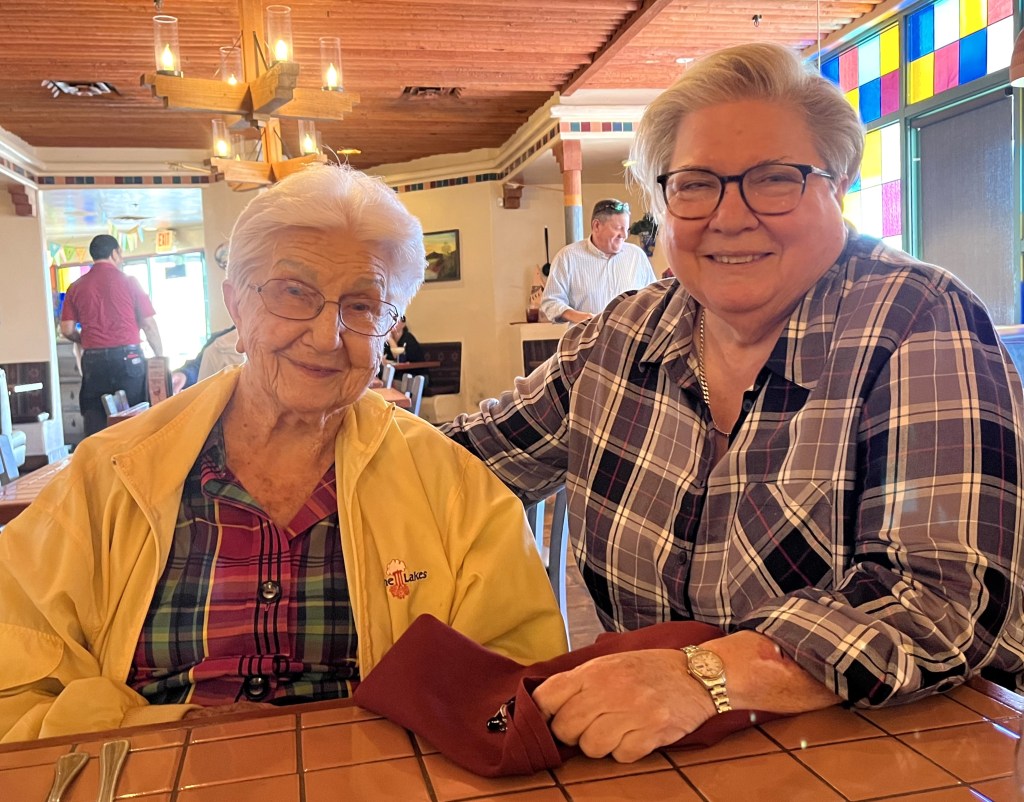
Since none of us can quite manage a birthday breakfast, lunch, and dinner all in the same day, we spread them out over the week. Today was a birthday lunch at our favorite Mexican restaurant, Coyotes. The best steak fajitas I’ve ever had!

Since none of us can quite manage a birthday breakfast, lunch, and dinner all in the same day, we spread them out over the week. Today was a birthday lunch at our favorite Mexican restaurant, Coyotes. The best steak fajitas I’ve ever had!

Years ago, a restaurant at Main Street Station here in Las Vegas served a chicken marsala that I had every time I was there. The restaurant has been gone for a decade or two and I have been looking for a chicken marsala dish that would match it ever since to no avail.
A friend sent me a recipe for it the other day from “The Kitchn”, thinking that I might like to try making it myself. The comments in the recipe mentioned that marsala comes in both a “sweet” and “dry” variety. Some people say the two are interchangeable but I’m here to tell you they are not!
Using a good dry marsala allowed me to achieve a wonderful-tasting dish that did not have those notes of sweetness that I found so off-putting in all the dishes I have tried over the years. It’s a pretty simple recipe as well. Give it a try if you enjoy chicken.
Actually, you might want to give it a try even if you don’t do chicken: just use a lot more mushrooms; they’re delicious.
For the chicken:
1 cup all-purpose flour, divided
1 teaspoon kosher salt
4 boneless, skinless chicken breasts
3 tablespoons olive oil
2 tablespoons unsalted butter
For the Marsala sauce:
2 tablespoons unsalted butter, as needed
8 ounces cremini mushrooms, quartered
2 cloves garlic, minced
3/4 cup dry Marsala wine
3/4 cup low-sodium chicken broth
1/4 cup heavy cream
Serving options:
Cooked pasta, such as angel hair
Chopped fresh flat-leaf parsley leaves
Lemon wedges
Arrange a rack in the middle of the oven and heat to 200°F. Mix the flour and salt in a small bowl and set aside.
Working with 1 chicken breast at a time, place inside a gallon zip-top bag and pound with the flat side of a meat mallet or rolling pin to an even 1/4-inch thickness. Set the flattened chicken breast aside and repeat with the remaining breasts.
Return the flattened breasts to the bag and add the flour mixture. Seal the bag and shake to coat.
Heat the oil in a 12-inch straight-sided skillet over medium-high heat until shimmering. Add the butter, followed by 2 of the chicken breasts. Fry until golden-brown on both sides, 3 to 4 minutes per side. Remove the browned chicken to a baking dish or rimmed baking sheet. Repeat with the remaining 2 chicken breasts.
Cover the chicken with aluminum foil and place in the oven to keep warm.
Keep the heat on medium-high. If there isn’t grease left from frying the chicken, add up to 2 tablespoons more butter to the pan. Add the mushrooms and cook until their juices start to release, about 3 minutes.
Add the garlic and cook until fragrant, about 1 minute.
Add the Marsala and scrape the bottom of the pan to remove any browned pieces. Add the broth and simmer until reduced by half and starting to thicken, about 15 minutes.
Add the cream and return the chicken to the sauce. Cook until the sauce thickens and the chicken is well-coated, 3 to 5 minutes.
Serve the chicken and Marsala sauce over cooked angel hair pasta if desired. Garnish with chopped parsley and a squeeze of lemon.
Store leftovers in an airtight container in the refrigerator for up to 4 days.
I’m not sure where this recipe came from, but these are the easiest and best tasting oatmeal cookies I’ve ever made. I’ve now made 3 or 4 batches and they have turned out wonderfully delicious every time.
The recipe as given calls for a food processor. Apparently, it’s for a much bigger one then I have, as there is no way all those ingredients would fit in mine. I used a mixer to cream the butter and sugars and then added the rest of the ingredients.
Enjoy!
2 sticks softened butter
3/4 cup granulated sugar
3/4 cup light brown sugar
2-1/2 cups rolled oats
1-1/2 cups flour
1 teaspoon baking powder
1 teaspoon salt
2 cups raisins
2 eggs
2 teaspoons vanilla
Line a 9-by-13-inch baking dish with foil, leaving a 2-inch overhang on two sides; coat the foil with cooking spray. Preheat the oven to 350 degrees F.
Pulse 2 sticks softened butter with 3/4 cup each granulated sugar and brown sugar in a food processor until combined. Add 2 1/2 cups rolled oats, 1 1/2 cups flour and 1 teaspoon each baking powder and salt; pulse to combine. Add 2 cups raisins, 2 eggs and 2 teaspoons vanilla; pulse until large clumps form.
Spread in the prepared pan or press in using damp or oiled fingers.
Bake until the edges are set but the center is soft, about 35 minutes. Transfer to a rack and let cool completely in the pan.
One of the sides I fixed for Thanksgiving was baked potato. I got the recipe from one of America’s Test Kitchen sites; their recipes and research rarely steer me wrong. In this case, these actually are the best baked potatoes I’ve ever had.
Adjust oven rack to middle position and heat oven to 450 degrees. Dissolve 2 tablespoons salt in 1/2 cup water in large bowl. Place potatoes in bowl and toss so exteriors of potatoes are evenly moistened. Transfer potatoes to wire rack set in rimmed baking sheet and bake until center of largest potato registers 205 degrees, 45 minutes to 1 hour.
Remove potatoes from oven and brush tops and sides with oil. Return potatoes to oven and continue to bake for 10 minutes.
Remove potatoes from oven and IMMEDIATELY, using paring knife, make 2 slits, forming X, in each potato. Using clean dish towel, hold ends and squeeze slightly to push flesh up and out. Season with salt and pepper to taste. Serve immediately.
These were soooo good. The skin crackled as I cut into them and they were the perfect texture. I used a temperature probe in one of the potatoes to track the progress and judge when to start cooking other items. Even my huge potatoes only took an hour or so to cook at that high temperature.
For those of you who have not used ghee, it’s basically clarified butter that is simmered longer so that it acquires a “nuttiter” taste. It has a very high smoke point, over 400°F, which is really useful for browning or frying items. I love the stuff. I mean, what’s not to like about cooking food in butter? It is my “oil” of choice.
What I do not love, however, is making ghee. Here are the instructions from the “RealSimple” website:
To make ghee at home, melt at least one stick of butter in a small saucepan over low heat (you can easily melt several sticks for a larger batch of ghee). Within five to ten minutes, the milk solids will begin to separate from the melted butterfat and the water will evaporate. Turn up the heat to medium and continue to brown the sunken milk solids while allowing the remaining water content to evaporate. As the butter simmers, a layer of milk solids will form a white foam on top— this should be skimmed off. Continue to cook for another five to ten minutes until the milk solids have completely browned and you can smell notes of toffee.
Slowly strain the butter through a cheesecloth or sieve into the container of your choice, being careful not to get any milk solids mixed in. This product is pure butterfat, which is often referred to as “liquid gold” (aka ghee). Discard the last few tablespoons of butterfat and milk solids that remain in the pan.
https://www.realsimple.com/food-recipes/recipe-collections-favorites/popular-ingredients/how-to-make-ghee
That is most definitely not my idea of simple or easy, so I buy the stuff when I can. It used to be hard to find; I originally found it at Trader Joe’s, but even there it was fairly costly. I used it to make baklava, but not much else.
Now you can find it in most grocery stores, but it’s still a pricey item: generally a $1.00 an ounce or more. Imagine my joy, then, when I found it at Costco for a much more reasonable price. As a result, for the past year or so, I have been using ghee for almost all my frying, sauteing, or other cooking methods.
Two weeks ago, I opened my cupboard to find a near empty jar of ghee when I had thought I had a nearly full one. I immediately went online to see if I could get more from Costco. No joy, they don’t list it. Afraid that this meant they stopped carrying it at all, I braved the Costco parking lot and managed to get inside the store without being run over by cars or carts.
And joy of joys, there was my ghee sitting on the shelf. Costco sells it as a 2-pack of 22.5-ounce jars for just under $25. About $0.55 cents per ounce then. Way, way cheaper than I can find it anywhere else and worth every penny as far as I’m concerned.
Other nice characteristics of ghee are that it is shelf-stable for years and doesn’t even need to be refrigerated after opening. Also, it doesn’t turn rancid quickly like many oils.
Let’s just say I stocked up while I could and there are now several jars resting in the dark in my pantry.
For the first time in what seems like ages, I had some people over for dinner last night. Nothing too fancy for the most part: guacamole and chips, salad (provided by guests). tamale pie, and wine (also provided by guests).
I have all my Halloween decorations up and decided I should get into the spirit of things by having at least one Halloween dish. I checked out the internet for suggestions and here’s what I ended up with:

Guacamole with blue corn chips
I kept the main dishes simple because I decided to make a rather complicated dessert: Chocolate-Pumpkin Crepe Cake. This was really a bit ambitious for me as I have never even made crepes before and this recipe calls for 20 of them. Also there were a lot of mixing and then chilling steps involved. Fortunately, it’s best made a day ahead, so if I messed it up I had time to recover.
However, in spite of all the horror stories I have heard about making crepes, the process was actually quite easy. I didn’t have any trouble flipping the crepes or getting them out of the pan. In fact, it went so well, I am going to try my hand at “real” crepes (these were chocolate with pumpkin pie spice) sometime soon. I believe part of the reason things went well is that the crepes were small: I used an 8-1/2″ non-stick skillet.
I got 19 crepes out of the recipe plus enough of a 20th one to give mom and I a taste. The recipe said it served 12, but as I stood there looking at my little pile of crepes I was a bit dubious. Then I started spreading out the pumpkin-whipped cream filling. 19 crepes and 18 layers of filling later, I called it a night, put the cake in the fridge, and went to bed. Took about 4 hours, which was less than I had initially estimated.
Pulled the well-chilled cake out of the fridge in the morning and made a delicious chocolate ganache to pour over it. Also tried my hand at marshmallow “spiderwebs”. That part did not turn out particularly well. At any rate, here’s the result:


It did make 12 decently-sized servings. I am contemplating making another one sometime but perhaps with something like a raspberry cream-cheese filling.
Hope you all have a fun and safe weekend.
I hadn’t had a pop-tart in decades up until a few months ago when I ran across a big box of them at Sam’s Club. They are, of course, a quintessential ‘junk food’, but they’re good-tasting empty calories and easy for mom to toast.
I remember my Nana fixing brown-sugar cinnamon pop-tarts for us when they first came out back in the 1960s. They weren’t frosted back then and Nana slathered them with butter before serving them. They were awesome!
But apparently there is a large controversy in the pop-tart universe about whether this is appropriate or not; some people feel it is blasphemy to butter this already fatty, sugary treat and others feel that slathering butter on just makes a decadent treat even better. This was brought out into the open when a character in the “Family Guy” cartoon sang a song about buttering his treat.
These days most pop-tarts come with frosting and are available in many flavors. I’ve never tried any other than the brown-sugar cinnamon ones and personally, I don’t see the need for frosting on them, but I take what I can get. And I was all ready to weigh in on the side of those supporting the “better with butter” option when I found out they were buttering the FROSTED side!
No, no, a thousand times NO. You should butter the pastry side, not the frosted side! The butter simply slides off the frosting (in spite of the few slashes in it) and is lost. The ONLY proper method is to butter the pastry side. The butter still soaks in to the pastry and, as the pastry side is a bit concave, can pool there without running off the sides.
I hope if you had any strong feelings about this debate, I have now shown you the only proper side to take!
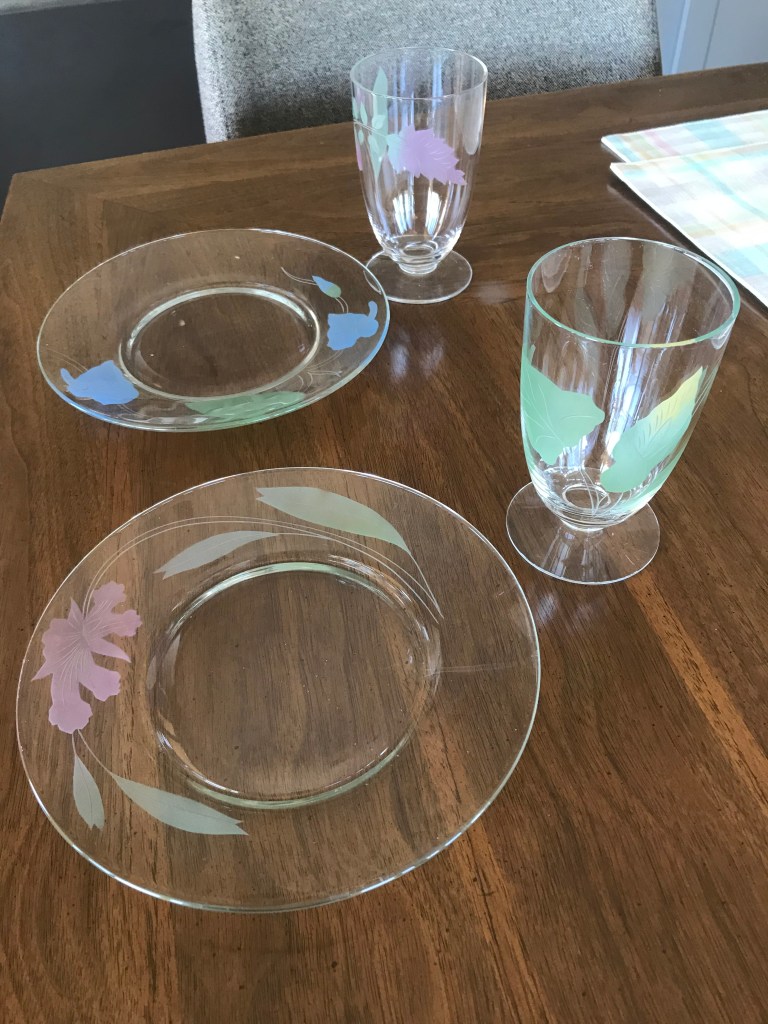
I had a few women over for lunch Sunday and decided my theme for the day would be the 1950s. I love any opportunity to use my mom’s glass flower plates, but they aren’t large enough for a regular dinner. I have used them before at mother’s day brunches and such things.
Each plate and glass has a different flower design on them; here are two of each:

These were a wedding present to my mom, so date from the 1940s; she still has the full set of eight.
All my recipes were dishes common in the 1950s:
We all had a good time and several of my guests had never even heard of some of the dishes.
Here’s the recipe for the dessert:
16 marshmallows
1/2 c milk
1/2 pint whipping cream
12 chocolate wafer cookies
red or green food coloring
mint flavoring to taste
Melt marshmallows and milk in top of double boiler. Whip cream and add marshmallow mixture when cool. Add flavoring and coloring. Pour into ice box trays line with crushed cookies. Sprinkle crushed cookies on top of dessert. Place in freezer for at least four hours. Serves 4.
Last night I had 3 fully vaccinated people over for dinner. What a delight to finally be able to cook and share a meal with some neighbors!
I had been looking through my cookbook last week trying to decide what to make for this occasion. I ran across a recipe I hadn’t made for years: Beef Birds with Bacon. This is the first recipe that I ever read and proceeded to make on my own. I was in high school at the time and, if I am remembering correctly, it was from Seventeen magazine. I made it several times for my family and then it somehow dropped off my rotation.
Here’s the recipe:
I made a few changes like cooking the bacon in the oven and using fresh mushrooms, but, on the whole, the recipe has stood up quite well over the last 50+ (!) years.
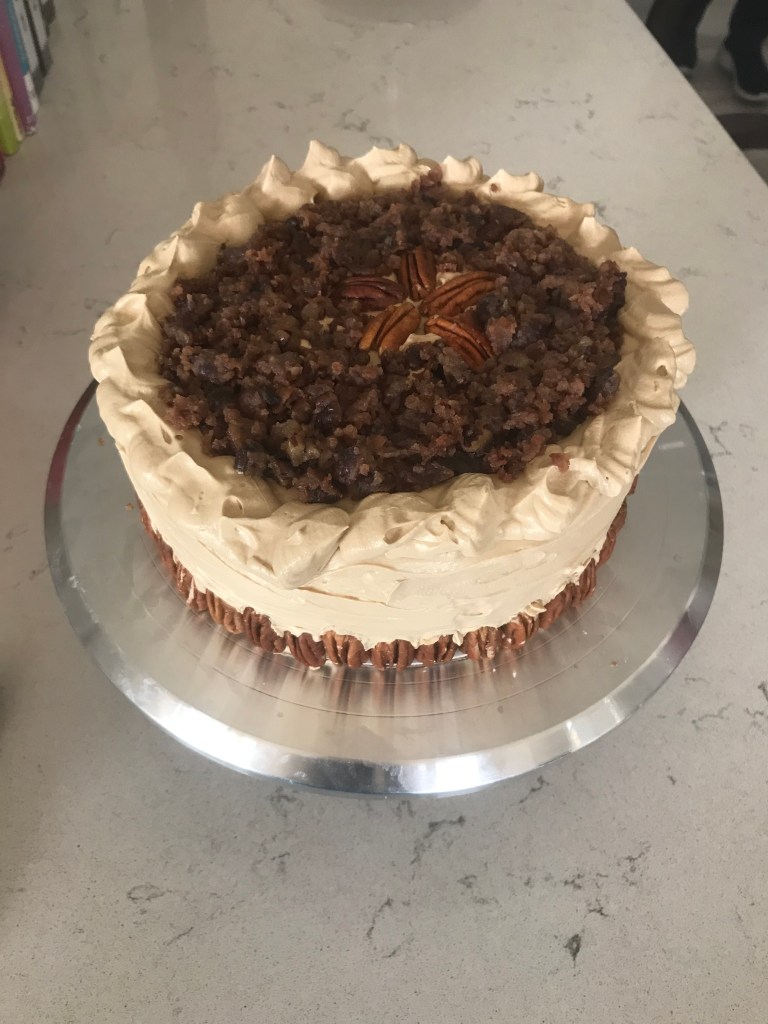
I also made a Pecan Pie Cake. It’s very good!

Here’s the recipe if you want to try it:
When I’m going through cookbooks trying to pick out recipes, I can usually visualize what they might be like. Every once in a while, though, I come across one that I haven’t a clue about and yet something about it makes me want to try it. This is one such recipe for me:
(You can replace the beef with kielbasa sausages, cutting them into 1/2-inch (12-mm) slices, which is basically what I did; I used some beef summer sausage that I had down in my freezer.)
There are reasons I didn’t know what to expect from this dish: I don’t fix soup very often, I don’t cook with cabbage much, and I have never made a sweet and sour dish before. And, yet, I kept coming back to this recipe.
Finally, last week, I decided it was time to try it. Mom doesn’t think much of cooked cabbage, but was willing to at least taste the dish. The only change I made (besides the meat) was to use a red cabbage I happened to have on hand. I knew there was enough acid in the dish to keep the color of the cabbage from going to blue.
Turns out this soup is freaking delicious!
Mom not only ate all I gave her, but was open to a second serving. And it made enough that I have two bags full of soup in the freezer to look forward to having at a later date.
The only thing I didn’t think worked out well was the use of whole (albeit smashed) tomatoes. I ended up cutting them into smaller pieces so that they were spread throughout the soup.
The other change I would make to the ingredients is that I would cut the cabbage in spoon-size pieces to make it easier to eat.
Here are the instructions:
Heat the oil in a large pot over low to medium heat. Add the onion and garlic and cook until
translucent, 2-3 minutes. Season the flank steak with salt and pepper, add to the pan, and cook, turning once, until lightly browned on each side, 2-3 minutes. Add the broth and stir and scrape with a wooden spoon to deglaze any browned bits.Add the tomatoes, crushing them slightly with the wooden spoon. Add the lemon juice, sugar, raisins, cabbage, and bay leaves. Raise the heat and bring to a boil. Reduce the heat to low, partly cover, and simmer gently until the meat is tender, about 1 hour.
Discard the bay leaves. Remove the meat from the pot and, using a sharp knife and a fork, cut and tear it up into coarse bite-sized pieces. Stir the meat back into the pot. Taste the soup and adjust the seasonings, if necessary. Ladle into warmed bowls and serve.
Very glad I tried this out; it’s a definite keeper!